
Off-grid Smart Locker Solution
Smart parcel locker electronics · off-grid & on-grid
Install parcel lockers and PUDO points anywhere.
No mains, no trenching, no battery rack.
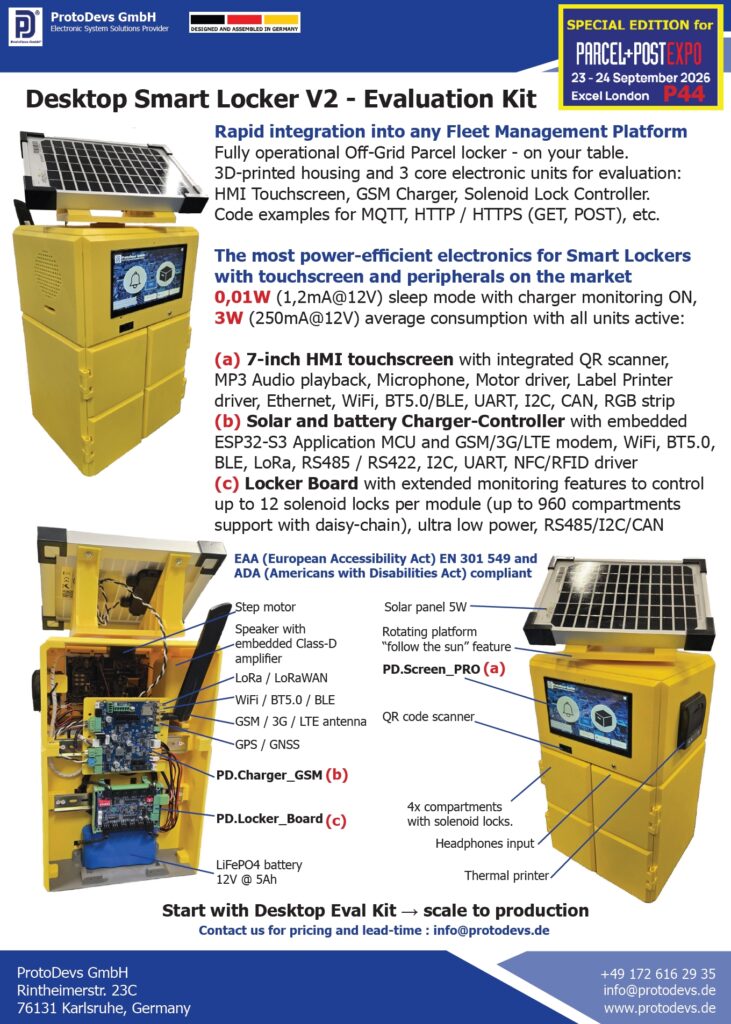
ProtoDevs modules run a complete smart locker or PUDO point on 3 W instant consumption with all systems on (12 V × 250 mA): 7″ touchscreen, GSM/LTE/GPS controller, solar/LiFePO₄ charger and lock boards. Between customers the locker switches to sleep mode, so in typical use it averages only ≈ 0.86 W, up to 22× less than an always-on PC platform. A compact battery and a small solar panel are enough, and on the grid the electricity bill shrinks by the same factor.
In mass production since 2024 · field-tested · R&D company from Karlsruhe, Germany
Request a quoteEnergy calculatorOff-Grid Solution Feasibility MapGet the evaluation kit
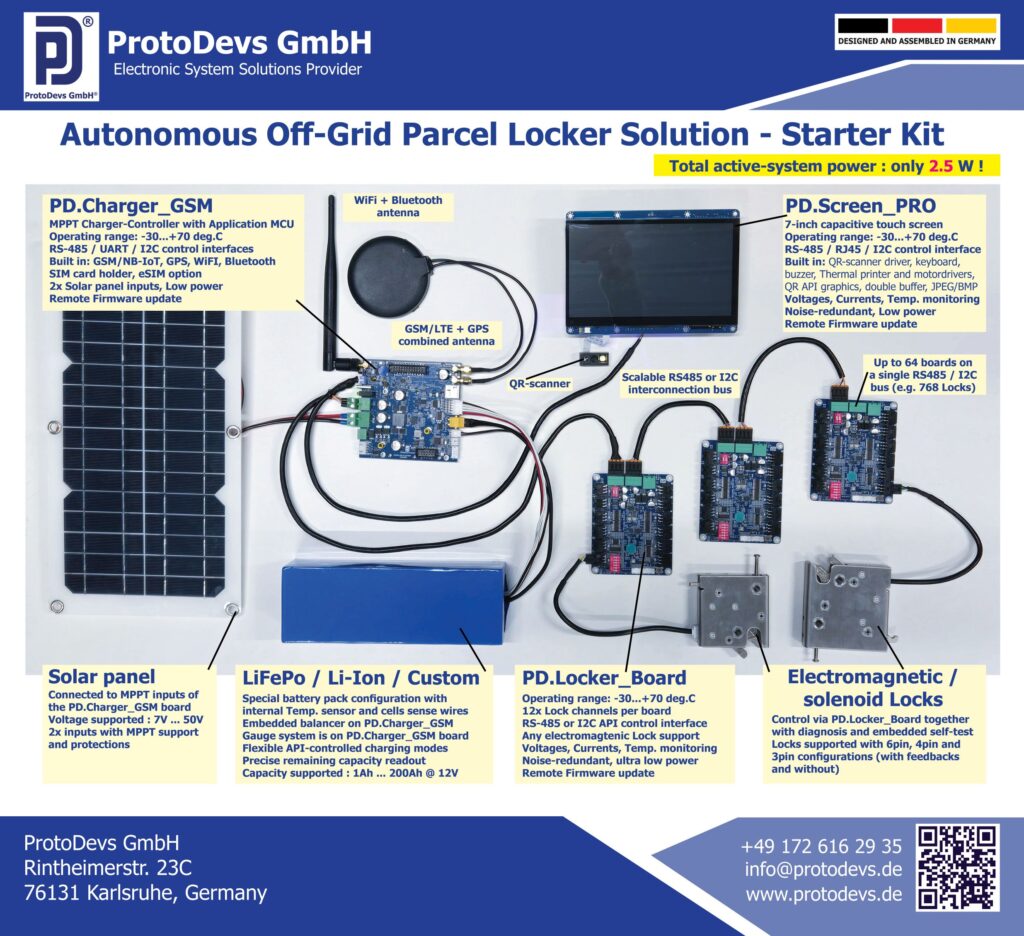
PD.Screen_PRO →PD.Locker_Board →PD.Charger_GSM →
3 W
instant consumption with all systems on, incl. 7″ screen (12 V × 250 mA)
up to 22×
less average energy than an always-on PC platform, thanks to sleep mode
−30 … +70 °C
operating temperature range for all ProtoDevs modules
2 – 3 days
integration with your fleet management platform
The off-grid challenge
Off-grid success depends on one thing: the battery.
PC and Raspberry Pi platforms are proven and flexible, and they are built for always-on operation. Together with a monitor and a 4G router they draw power day and night, so a battery for a dark month grows to hundreds of ampere-hours and needs a larger solar panel. ProtoDevs modules add a sleep mode between customers, so the same locker gets by with a much smaller battery.
Industrial PC inside
≈ 1,300 Ah
≈ 135 – 165 kg of LiFePO₄ ≈ 2,600 – 9,750 EUR per locker
Raspberry Pi inside
≈ 550 Ah
≈ 55 – 70 kg of LiFePO₄ ≈ 1,100 – 4,100 EUR per locker
ProtoDevs modules inside
≈ 60 Ah
≈ 7 kg of LiFePO₄ ≈ 120 – 450 EUR per locker
Battery for 31 days without sun. 12 V LiFePO₄, 90 % usable capacity, no cold derating, typical use: 7-inch screen on 1 h per day and in sleep mode the rest of the day, 20 door openings per day. Average power: ProtoDevs ≈ 0.86 W (sleep mode ≈ 0.01 W with charger monitoring on), Raspberry Pi ≈ 8 W, industrial PC ≈ 19 W (computers stay on 24 h). PC / Raspberry Pi values are typical assumptions. EU retail battery prices approx. 2 – 7.5 EUR/Ah (Nov 2026). With a 60 Ah battery, ProtoDevs electronics run ≈ 31 days without sun. With the screen always on (3 W), plan ≈ 210 Ah for the same 31 days.
PD.Gateway · magic button mode
A year without sun, on a compact battery.
For lockers that must run on battery alone, use PD.Gateway as the controller. Its STM32 guard is the only part that stays awake, at about 1 mA. Between customers it switches PD.Screen and all PD.Locker_Boards off completely and puts the ESP32-S3 into deep sleep.
One push button on the front, the magic button, wakes the whole locker: booted and touch-ready in less than one second. After the customer leaves, everything goes back to sleep.
0.14 W
calculated average power · 3.3 Wh per day
≈ 12 months
calculated, without any sun, on 150 Ah (1,920 Wh)
≈ 16.5 months
calculated, without any sun, on 230 Ah (2,944 Wh)
| Locker electronics | Screen | Average power | Runtime on 150 Ah | Runtime on 230 Ah | Basis |
|---|---|---|---|---|---|
| PD.Screen and PD.Locker_Boards with PD.Gateway | 7″ | 0.14 W | ≈ 12 months | ≈ 16.5 months | calculated |
| PD.Screen and PD.Locker_Boards with PD.Gateway | 10″ | 0.23 W | ≈ 8.4 months | ≈ 11.8 months | calculated |
| Raspberry Pi-based electronics, always on | 7″ | ≈ 8 W | ≈ 9 days | ≈ 14 days | typical assumption |
| Industrial PC-based electronics, always on | 7″ | ≈ 19 W | ≈ 4 days | ≈ 6 days | typical assumption |
Calculated values, not measurements. Assumptions: no solar input, 1 hour per day all systems on, STM32 guard 1 mA in sleep, 12.8 V LiFePO4 with 90 % usable capacity, about 2 % per month self-discharge; 10″ values for a 34-door locker from our locker builder. Raspberry Pi and industrial PC values are typical always-on assumptions from our energy calculator, not measurements of a specific product. Real runtime depends on usage, temperature, battery and configuration; we are happy to size your project.
See the PD.Gateway product page or size your own locker in the off-grid calculator.
What changes for you
Smaller battery. Smaller panel. Faster rollout.
Place lockers where people are
Car parks, train stations, villages, campuses: no mains connection, no groundworks, no electrician. Installation in hours, not weeks.
Lower cost per site
A compact battery and a small solar panel instead of a battery rack. Less freight, less cabinet space, fewer service visits.
Remote control of every site
LTE-M / NB-IoT status, alarms, battery health and door events go straight to your fleet platform via MQTT or HTTPS.
Also on the grid (plug-in)
Same electronics, a fraction of the electricity bill.
Power the locker from a standard socket via a small 12 V supply, from PoE over LAN, any 9 – 48 V DC source or USB-C. The LiFePO₄ battery on PD.Charger_GSM keeps the locker working during power cuts.
Electricity bill · 5,000 lockers · 5 years (Germany)
Saving up to 1.29 M EUR with ProtoDevs modules.
0.2957 EUR/kWh excl. VAT (Eurostat 2026-S1, <20 MWh band), 90 % power-supply efficiency, same typical use as above. Prices for every EU country on our Off-Grid Parcel Locker Calculator page.
One platform · drop-in modules
Everything a smart locker needs, designed to work together.
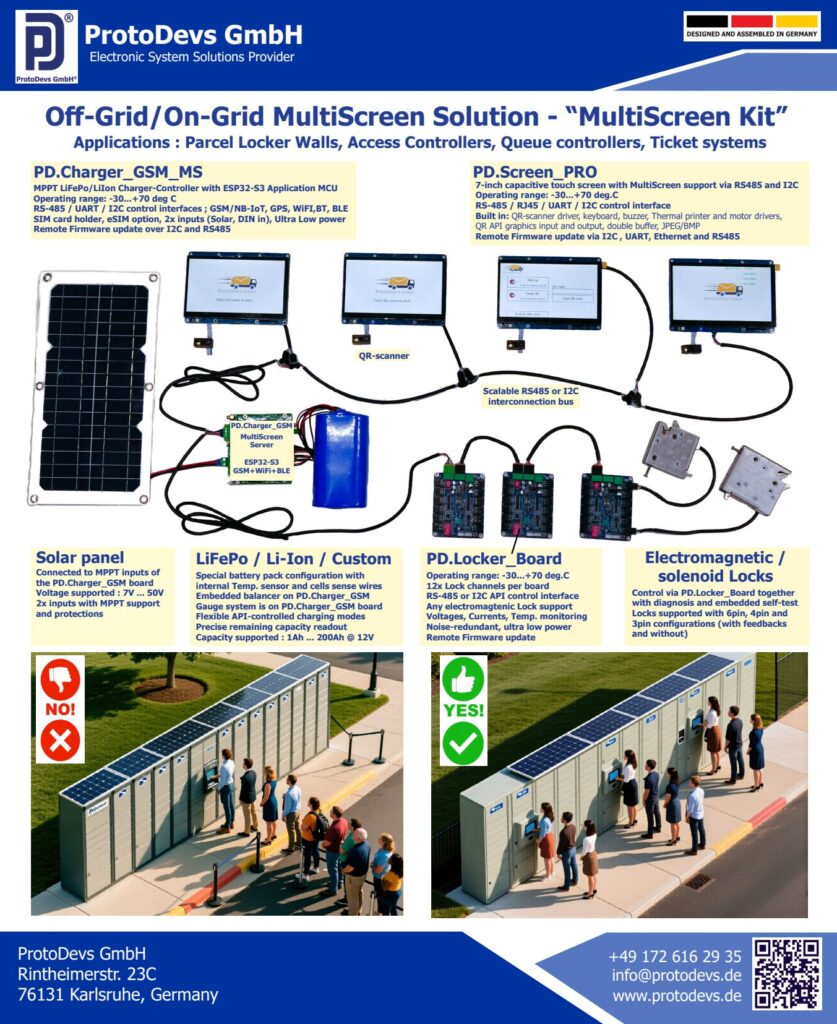
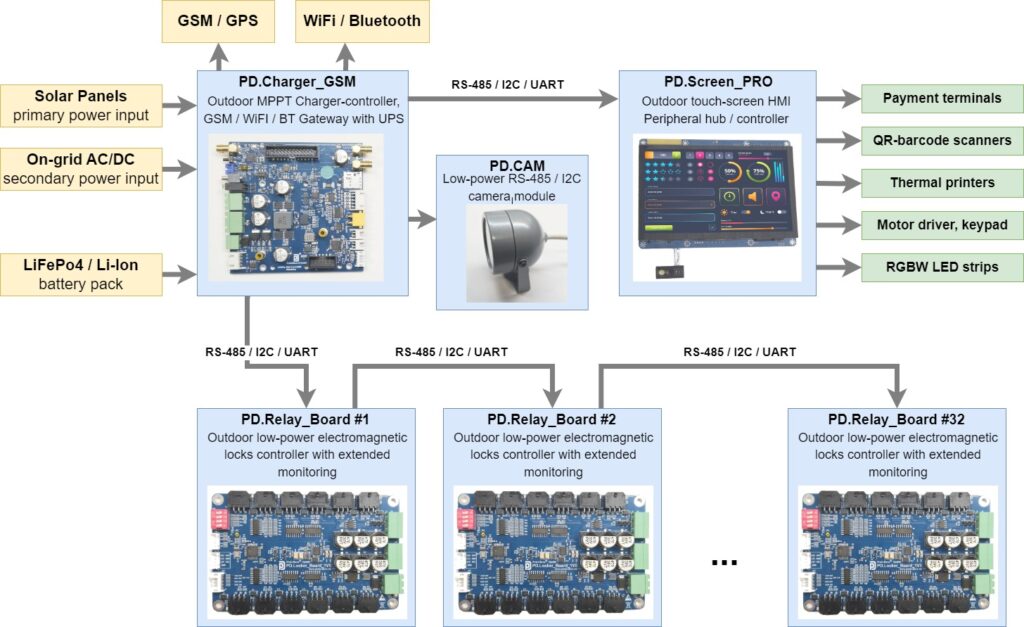
PD.Screen_PRO 7″ / 10″: the locker’s brain and face
Capacitive touchscreen with dual MCU: ESP32 for application logic, security and cloud; STM32 for graphics and touch. Boots in 1 second. High-level commands, no graphics expertise needed.
Control & monitoring interfaces
Onboard peripherals
Power
PD.Charger_GSM: power & connectivity
Solar MPPT charger, LiFePO₄ charging, protection, gauge and balancer. Always-on STM32 supervisor (≈ 1 mA) and ESP32 with SIM7080G LTE-M / NB-IoT, GPS, WiFi and Bluetooth. Crypto co-processor for security.
PD.Locker_Board: lock control
Up to 12 locks per board on RS-485, many boards per bus. Open/close feedback, voltage and current per lock for delivery confirmation, tamper detection and predictive maintenance. About 2 mA idle. Supports all Kerong locks and other popular locks.
Optional modules
- ✓PD.Cam: ultra-low-power RS-485 / I²C camera with IR and RGB LEDs
- ✓PD.Multicontroller: parcel weight, temperature and presence sensing
- ✓Battery heating for charging in cold weather
- ✓Up to 64 PD.Screen_PRO on one bus for parallel customer and courier queues
Secure by design
Embedded security by design
- ✓MCU firmware without a general-purpose OS: small attack surface, fewer updates
- ✓SIM cards without public IP, outgoing connections only
- ✓No backdoors, no master passwords
- ✓Open ESP32 code: audit it and update your fleet yourself
- ✓No DDR4 / DDR5 / LPDDR: stable BOM during memory price spikes
Accessible by design
Ready for the European Accessibility Act
- ✓Compact 7″ or 10″ screen fits the 800 – 1,100 mm reach zone of EN 301 549
- ✓Spoken guidance via speaker and headphone jack
- ✓QR, keypad, NFC and Bluetooth app opening as alternative channels
- ✓Large-font, high-contrast UI, fully brandable
From kit to pilot
Your first locker, connected in 2 – 3 days.
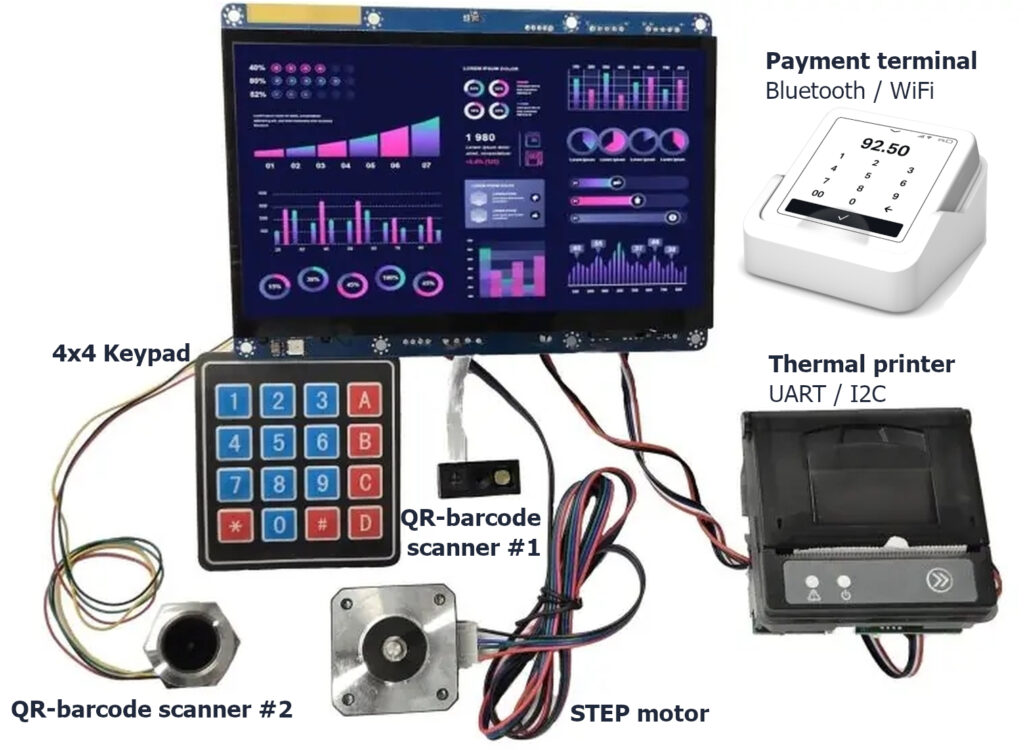
Working examples for HTTP / HTTPS and MQTT / Secure MQTT, plus libraries for QR scanner, thermal printer, keypad, GSM, GPS, WiFi and camera. Develop in Arduino IDE, PlatformIO, ESP-IDF or MicroPython.
Unbox
Screen, charger, locker board, battery and cables in one kit.
Run an example
Start from the desktop-locker Arduino example or the HTTP/MQTT examples.
Connect your platform
Map your API or MQTT topics: open, status, alarms, battery.
Pilot in your cabinet
Wire your locks, add a solar panel or plug it in, and go live.
Try it in your own locker
Get the evaluation kit.
- ✓PD.Screen_PRO 7″
- ✓PD.Charger_GSM
- ✓PD.Locker_Board (supports all Kerong locks and other popular locks)
- ✓LiFePO₄ battery (20 / 40 / 60 / Custom Ah)
- ✓All cables included
Free customization of the electronics for mass-production orders. Contact us for a price request and lead times.
Documents & downloads
Everything your engineers need
| Document | Link |
|---|---|
| PD.Screen_PRO datasheet | Request |
| PD.Charger_GSM datasheet | On request |
| PD.Locker_Board module page | Open |
| Online calculator: battery size & energy cost for every EU country | Open |
| Online energy calculator (Google Sheets) | Open |
| Arduino example: desktop parcel locker set | Code |
| 3D STL files: desktop parcel locker set | On request |
| PD.Cam datasheet | Coming soon |
Interactive 3D model · Desktop parcel locker
drag to rotate · scroll to zoom · ⛶ fullscreen


Comparison
How ProtoDevs modules fit your locker
| ProtoDevs platform | Tablet / PC / Raspberry Pi | Own discrete design | |
|---|---|---|---|
| Instant power, all systems on | 3 W | ≈ 13 – 32 W | varies |
| Average power, typical use* | ≈ 0.86 W | ≈ 8 – 19 W | varies |
| Battery for 31 days off-grid | ≈ 60 Ah | ≈ 550 – 1,300 Ah | depends on design |
| Electricity, 5,000 lockers, 5 years (DE) | ≈ 61.7 k EUR | ≈ 0.57 – 1.35 M EUR | varies |
| Solar charger, BMS and LTE in one module | ✓ | via separate devices | custom development |
| Per-lock current & state monitoring | ✓ | optional, depends on setup | custom development |
| Operating system to maintain | none (MCU firmware) | Windows / Linux / Android | own firmware |
| DDR memory in the BOM | ✓ none | DDR4 / DDR5 / LPDDR | depends |
| Operating temperature | −30 … +70 °C | typ. 0 … +50 °C | depends on design |
| Time to first pilot locker | days | weeks | months |
* Screen on 1 h per day, sleep mode the rest of the day; computers stay on 24 h. Tablet / PC / Raspberry Pi values are typical assumptions, not measurements of a specific product. All inputs can be changed in the online calculator.
Data and remote control
What your platform receives from every device.
The STM32 guard (charger and battery monitor) on PD.Gateway, PD.Charger and PD.Charger_GSM measures everything below. Your platform gets it through the ESP32-S3 or the modem, and can change the settings remotely:
Locker (PD.Locker_Board)
- Door and lock events, open / closed state of every lock (up to 12 per board)
- Microswitch voltage and control-pin voltage of each lock
- Board current, supply voltage and voltage at the power connector (X16)
- Board and MCU temperature
- Firmware revision, API version and MCU device ID
- Error code for every command, including CRC32 checksum errors
- Alarms
- Remote: open a lock with microswitch confirmation or send a timed open pulse
- Remote: board reset and firmware update over the bus
Battery (battery gauge)
- State of charge (%), remaining and full-charge capacity
- Voltage, current and average current
- Individual cell voltages (up to 5 cells)
- State of health (SOH) and cycle count
- Battery temperature
- Estimated time to empty and time to full
- Battery, charging, gauging and safety status, protection alerts
- Under- and over-voltage snapshots, lifetime data
Solar and charging
- Input (solar / DC) voltage and current
- Charge voltage and charge current
- MPPT status and detected maximum power point
- Charger status and fault flags
- NTC temperature reading
System and diagnostics
- Firmware version and build date, hardware version
- Uptime and MCU restart reason
- Real-time clock timestamp
- Initialisation and error status
- Auxiliary analogue input (X7)
Configurable remotely (write)
- Charge voltage and charge current limits
- Input current and input voltage limits, precharge and termination current
- MPPT on / off, battery capacity, cell balancing
- Charging cut-off outside the safe temperature range
- Ship mode on deep discharge, battery FETs on / off
- Modem power cycle, real-time clock
- Firmware update of the charger MCU (STM32)
Available through the documented ProtoDevs charger API (I²C or UART) and PD.Locker_Board API (RS-485), both with optional CRC32.
FAQ
Frequently asked questions
How long does a locker run without sun?
In typical use (7-inch screen on about 1 h per day, sleep mode the rest of the time) the complete ProtoDevs set averages about 0.86 W, so a 12 V LiFePO₄ battery of 60 Ah covers about 31 days without sun. With all systems on, the instant consumption is 3 W (12 V × 250 mA); if the screen has to stay on 24 h, plan about 210 Ah for the same 31 days. Our online calculator lets you enter your own screen time, number of boards and battery size.
Can it run on the grid instead of solar?
Yes. Power it from a socket via a small 12 V supply, from PoE or any 9 – 48 V DC source. The LiFePO₄ battery bridges power cuts, and the low consumption cuts the electricity bill of a 5,000-locker fleet from about 1.35 M EUR (industrial PC) to about 61.7 k EUR over 5 years.
Does it work in winter?
The modules are rated −30 … +70 °C. LiFePO₄ cells must not be charged below 0 °C, so we offer optional battery heating for cold sites.
Can we use our own cabinet and locks?
Yes. The modules are drop-in electronics for your existing cabinet. PD.Locker_Board supports all Kerong locks and other popular locks, up to 12 per board and many boards per RS-485 bus.
How do we connect it to our fleet management system?
Typically in 2 – 3 days, starting from our HTTP/HTTPS and MQTT / Secure MQTT examples. The ESP32 application code is open to you.
Is it secure?
The locker runs MCU firmware without Windows or Linux, uses SIM cards without public IP, makes only outgoing connections and contains no backdoors or master passwords.
Is it suitable for OEMs and large networks?
Yes. It scales from one private locker to country-wide networks, and we customize the electronics free of charge for mass-production orders.
Keep your locker. Upgrade the electronics.
We work as a hardware partner for locker makers: you keep your cabinet, software and brand. Tell us how many lockers you plan and where. We will send the battery and solar sizing for your sites together with a quote.